You're standing in the Strand Bookstore on Broadway and 12th, a place that smells like dust and ambition and has been selling books since 1927. You've got eighteen miles of shelving around you, and you're doing what everyone does in the Strand: you're judging books you haven't read.
Two catch your eye on an end-cap display. The first was published six weeks ago. The cover is gorgeous — matte black with embossed gold lettering, the kind of design that screams "I won awards." Blurbs from three people you've heard of. "A masterpiece of contemporary nonfiction," says the New York Times. The second book has a faded cloth binding, no blurbs, and a publication date of 1960. You've vaguely heard of it. Your friend's dad had a copy. The title rings a bell the way a half-remembered song does.
Here's the question: which one will still be in print in 2050?
Your instinct — trained by a culture that worships novelty, that ranks bestseller lists weekly, that treats "new" as a synonym for "better" — says bet on the shiny one. It has momentum. It has reviews. It has a publicist.
But there's an old heuristic, born in the delis and comedy clubs of midtown Manhattan, that says your instinct is dead wrong. That heuristic has a name: the Lindy effect. And it says bet on the book from 1960. Not because it's better (though it might be), but because it's still here. Every year a book survives is evidence — not just that it survived, but that it has whatever invisible qualities make things last. The new book has six weeks of evidence. The old one has sixty-five years. And if the Lindy effect holds, that old book's expected remaining lifespan is proportional to its current age. It's not just likely to be around in 2050 — it's likely to be around in 2090.
The new book, statistically speaking, is probably already dying.
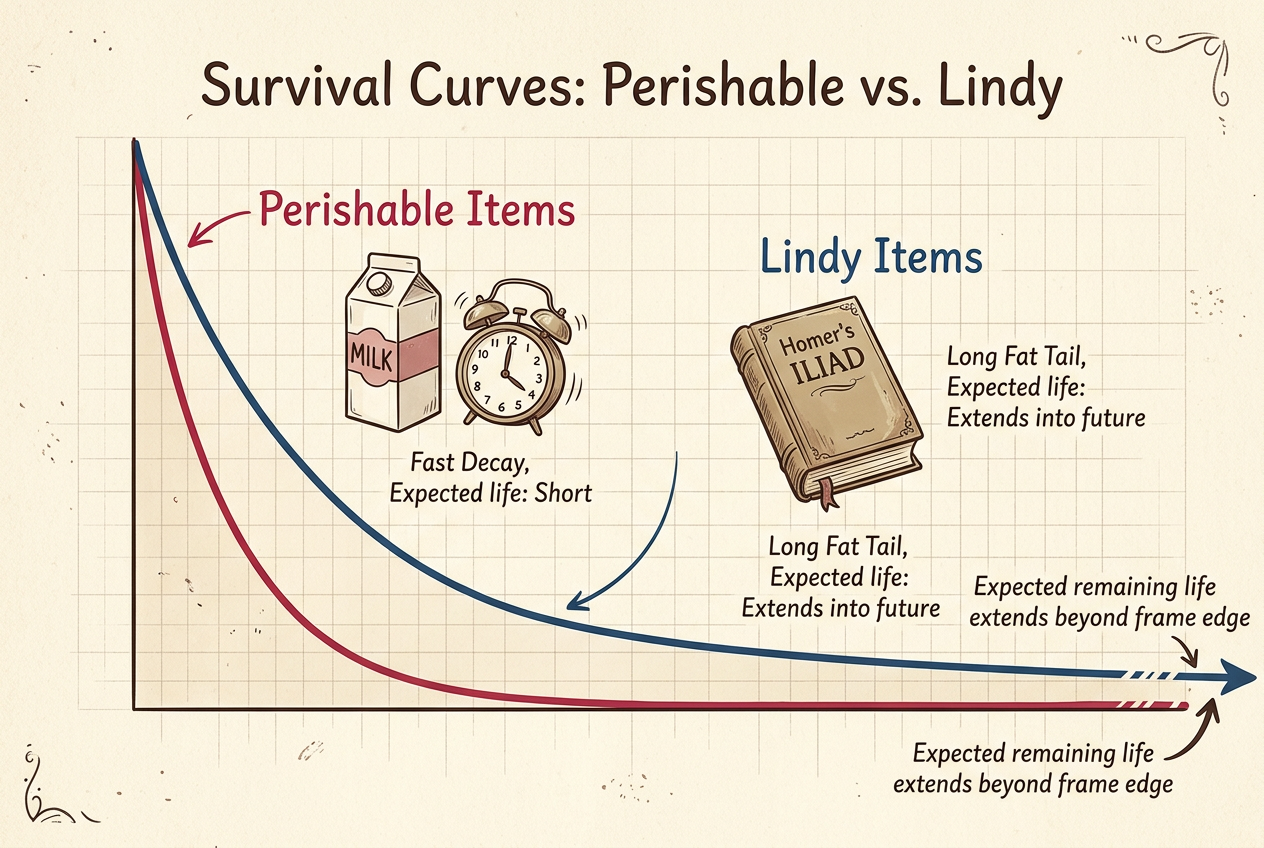
The Lindy effect gets its name from Lindy's, a delicatessen on Broadway near Times Square where, according to legend, New York comedians would gather in the 1960s and debate how long each other's careers would last.1 The comedians noticed something: the shows that had been running the longest tended to keep running. A Broadway show that had survived a year was likely to survive another year. One that had survived ten years? Probably good for ten more. The young shows were the fragile ones. The old shows had proven something.
Benoit Mandelbrot — yes, the fractal guy — picked up on this in 1982 and gave it a more precise formulation. For a certain class of things, he argued, the expected remaining lifespan is proportional to the current age.2 Nassim Nicholas Taleb later grabbed this idea, sharpened it, generalized it, and turned it into a centerpiece of Antifragile (2012), arguing that the Lindy effect is one of the most powerful and underused heuristics available to anyone making decisions under uncertainty.3
But here's what makes Lindy more than a heuristic — it has a mathematical backbone, and the backbone has teeth.
Chapter 1The Math Under the Cheesecake
The Lindy effect falls out naturally from power-law survival distributions. Here's the intuition.
Imagine you're tracking how long things last — technologies, books, Broadway shows, companies. You plot a histogram. Most things die young. A few hang on for decades. A tiny number seem to last forever. The distribution has a long, fat tail stretching to the right: lots of short-lived things, a few ancient survivors.
This kind of distribution — technically a Pareto distribution — has a remarkable property. If you've already survived to age t, your expected remaining life isn't fixed. It's proportional to t itself.
Let's write it down. If the survival time T follows a Pareto distribution with shape parameter α > 1, then the expected remaining life given that you've already survived to age t is:
Lindy Expected Remaining Life
E[T − t | T > t] = t / (α − 1)
When α = 2: expected remaining life = current age
- t
- Current age — how long the thing has already survived
- α
- Shape parameter of the Pareto distribution (typically 1.5–3 for cultural artifacts)
- E[…]
- Expected value — the average remaining lifespan given survival to age t
When α = 2 — a common empirical value for many cultural and technological artifacts — this simplifies to something beautiful: your expected remaining lifespan equals your current age. A book that's been in print for 50 years? Expect another 50. A technology that's been around for 100 years? Expect another 100.
This isn't optimism. It's not nostalgia. It's a direct mathematical consequence of how non-perishable things die.
Lindy Effect Predictor
Enter an item's age or pick from real-world examples. See how long Lindy predicts it will last.
Expected Remaining Lifespan
50 years
A 50-year-old item should last roughly another 50 years
50% CI
12 – 100 yrs
90% CI
2 – 950 yrs
Timeline
Books
Technologies
Programming Languages
Companies
Why You Won't Live to 200
Here's where most people go wrong with Lindy, and it's worth spending a minute on because the error is seductive.
A 90-year-old human has survived a very long time. Does the Lindy effect predict she'll live another 90 years? Obviously not. She's more likely to die this year than a 20-year-old is. What gives?
The distinction is between perishable and non-perishable things. Humans are perishable. We have biology. We have organs that wear out, cells that stop dividing, arteries that harden. Our hazard rate increases with age — the older you get, the more likely you are to die in the next year. That's not a power law. That's closer to exponential decay with an increasing failure rate.
Books don't have arteries. Technologies don't get cancer. An idea doesn't develop atherosclerosis at age 300. These things are non-perishable — they die from external causes (cultural shifts, competition, obsolescence), not from internal decay. And external causes produce exactly the kind of power-law survival statistics that generate the Lindy effect.
Taleb puts it crisply: "The perishable is necessarily aging. The non-perishable may be aging in reverse."4
So the Lindy rule comes with a giant asterisk: it only applies to non-perishable things. Technologies, cultural artifacts, ideas, institutions, cuisines, mathematical theorems, religions, musical genres. Not organisms, not individual machines, not anything with a biological or mechanical clock ticking inside it.
How do you tell the difference? Ask yourself: does this thing age? Not "does it change" — everything changes — but does it have an internal mechanism pushing it toward failure? A car has one (engine wear, rust). A recipe does not. A business might or might not, depending on how its competitive position works. This is judgment, not formula. Lindy is a Bayesian prior, not a law of physics.
Choosing Your Stack (and Your Dinner)
Here's where Lindy gets practical, and where it starts earning its keep as a genuine decision-making tool.
Technology choices. You're a software developer in 2025, and you need to pick a programming language for a new project. Do you go with the language released last year that has beautiful syntax and excited blog posts? Or do you pick C, a language from 1972 that's been called ugly, dangerous, and outdated for at least 30 of those years?
Lindy says: C will almost certainly still be in use in 2050. The new language might be dead by 2030. This doesn't mean C is better for your project — Lindy says nothing about quality. It says something about survival. And if you're building something you want to maintain for 20 years, survival matters.
Restaurant choices. You're in a new city. You can go to the buzzy restaurant that opened three months ago — packed, Instagrammable, "molecular gastronomy meets comfort food." Or you can go to the neighborhood trattoria that's been there since 1985. Lindy says the trattoria will be there in 2060. The molecular gastronomy place might not survive 2026.
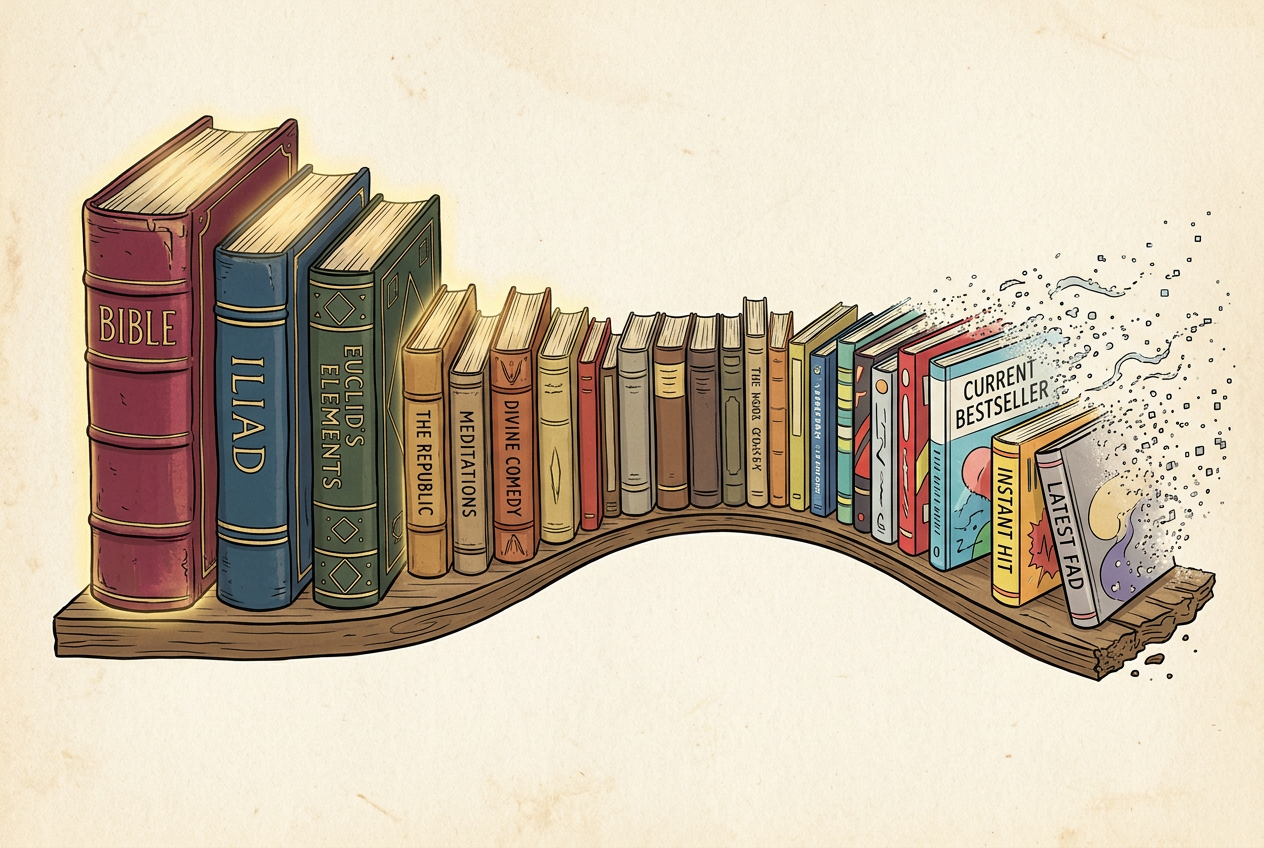
Book choices. If you have limited reading time (and who doesn't), Lindy offers a powerful filter. A book from 1850 that people still read has survived 175 years of competition from millions of other books. That's an extraordinary signal.6
Lindy or Not?
For each matchup, predict which item will outlast the other. See how your intuitions align with the Lindy heuristic.
When Lindy Lies
You knew this section was coming, and it matters more than the rest.
The Lindy effect is a prior, not an oracle. It tells you what to expect in the absence of other information. But you usually have other information, and sometimes that information overwhelms the prior.
Network effects. A social network's value depends on how many people use it. If a competing network achieves critical mass, the old one can die overnight, regardless of age. MySpace was 8 years old when it became irrelevant.7
Paradigm shifts. The horse-drawn carriage had been the dominant mode of personal transport for roughly 3,000 years when the automobile appeared. Lindy would have predicted another 3,000 years. The carriage was functionally extinct within 40.
Artificial life support. Some things survive not because of organic demand but because of institutional inertia. COBOL is 66 years old, but much of its survival is due to the staggering cost of replacing it in legacy banking systems.
Convexity breaks. Lindy assumes the future looks statistically like the past. If the process itself changes (new regulation, AI disruption, climate change), the historical survival data becomes less informative.
None of these objections destroy Lindy. They calibrate it. Lindy is the right starting point — the right prior — for most non-perishable things. But like any prior, it should be updated when you get new evidence.
The Bookshop, Revisited
Let's go back to the Strand. You're still holding those two books. The 1960 book and the six-week-old one.
You now know that the 1960 book has something the new book doesn't: a track record of not dying. Sixty-five years of not going out of print. Sixty-five years of readers finding it, buying it, recommending it, assigning it in courses, gifting it at graduations. That's not nothing. That's sixty-five years of a kind of election — millions of individual decisions that this book is worth keeping alive.
The new book might be brilliant. It might be the next classic. But right now, it's just a candidate — one of roughly 4 million books published per year8 — and the vast majority of those will be gone in five years.
This is the deep lesson of the Lindy effect, and it's not really about math at all. It's about humility in the face of the new. We live in a culture that fetishizes novelty — new apps, new frameworks, new restaurants, new ideas, new books. And novelty has real value. Every classic was once new. But survival is information, and old age — for the non-perishable — is the most powerful information there is.
The next time someone tells you about the hot new thing that's going to change everything, remember the comedians at Lindy's deli, arguing over cheesecake about whose show would last. The smart money wasn't on the flashiest act. It was on the one that was already old.
The Punchline
That deli, by the way? Lindy's closed in 2018, after 97 years. Which means it lasted long enough to prove its own theorem — and then, because delis are at least partly perishable (leases expire, neighborhoods change, owners retire), it proved the theorem's limits too. Even Lindy isn't Lindy forever.